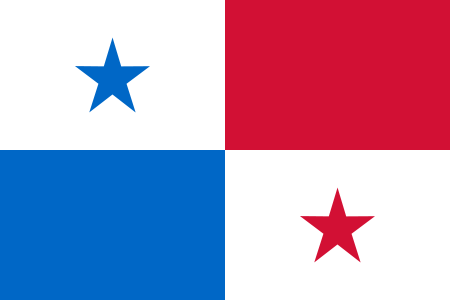
Panama had a rich Pre-Colombian history with its native populations who have lived here over 12,000 years. Central Panama was the site of some of the first pottery-making villages in the Americas. The Monagrillo culture dates from 2500-1700 BC. These populations are best known from the spectacular burials of the Conte site (dating to c. AD 500-900) and the beautiful polychrome pottery of the Coclé style. At the time of European conquest, the indigenous population was said to be between one and two million people.

In 1501, Rodrigo de Bastidas from Seville, who had accompanied Columbus on his second voyage to the Americas, reached La Punta de Manzanillo on Panama's upper Caribbean coast. He is the first European to have claimed that part of the isthmus. Panama at that time was settled by Chibchan, Chocoan, and Cueva peoples, among whom the largest group were the Cueva. A year after de Bastidas, Christopher Columbus sailed south from the Costa Rica. Columbus produced maps of Panama's coastline. He landed at Almirante and continued to Portobelo (Beautiful Port).
Vasco Núñez de Balboa, who had been on de Bastidas's ship in 1501, trekked from the Atlantic to the Pacific in 1513 and was able to verify that the isthmus had another coast and that there was another ocean, the Pacific.
Balboa's discovery of another ocean led to Panama's use by colonial Spain as a route for Peruvian treasures to be taken from the Pacific to the Atlantic. The Spanish effectively removed most native cultures by looting and enslavement of the indians. By the late 17th century, Cueva culture had disappeared. Indian cemeteries were looted for the pre-Colombian gold treasures they contained. The route that the Spanish created across the isthmus was called Camino Real, or Royal Road, although was more commonly known as Camino de Cruces.
In 1698, Panama was the site of the ill-fated, Darién scheme, whose aim was to set up a Scottish trading colony. This scheme and the resulting financial losses played a significant part in influencing the eventual union of Scotland with England in 1707.
Panama was part of the Spanish Empire for 300 years (1538-1821). Panama's importance to Spain declined towards the end of the 17th century and fade almost altogether by the middle of the 18th as Spanish ships began to go round Cape Horn to reach the Atlantic, in order to avoid being ambushed by enemy ships in the Caribbean.
In 1821 Pamana joined with present day Venezuela, Colombia and Ecuador to form 'Gran' or Greater Colombia. In September 1830, General José Domingo Espinar, the local military commander rebelled against the country's central government, and Panama separated from Greater Colombia and requested that general Simón Bolívar take direct command of the isthmus department. By early 1831 Panama had reincorporated itself to what was left of Greater Colombia, which had adopted the name of Republic of New Granada.
By July 1831, as the new countries of the Venezuela and Ecuador were being established, Panama again declared its independence, but by August had re-united with New Granada.
In November 1840, General Tomás Herrera, declared its independence, but again re-united with Columbia on December 31, 1841.
In 1846, the United States and Colombia signed the Bidlack Mallarino Treaty, granting the U.S. rights to build railroads through Panama, and also gave the USA the power to intervene by force to guarantee Colombian control of the isthmus. Between 1850 and 1903, the USA used troops to suppress independence revolts several times. The first such conflict was known as the Watermelon War of 1856.
In 1855, the first Transcontinental railway of the New World, the Panama Railway, was built across the isthmus from Colón to Panama City to transport gold prospectors wanting to access the gold fields of California.
Modern Panamanian history has been shaped by the possibility of a canal to replace the difficult overland route. In the 1520s , the Spanish crown ordered surveys of the isthmus to determine the feasibility of such a canal, but never progressed the idea. . From 1880 to 1889, the French Compagnie Universelle du Canal Interocéanique under the direction of Ferdinand de Lesseps, who had built the Suez Canal, attempted to construct a sea-level canal. Eventually yellow fever and malaria as well as engineering problems caused this project to be abandoned.
U.S. President Theodore Roosevelt convinced U.S. Congress to take on the abandoned works in 1902. The US encouraged a handful of Conservative Panamanian landholding families to demand a Panama independent from Colombia. The USS Nashville was dispatched to Colón to deter any resistance from Bogotà and so, on November 3, 1903, with United States' encouragement and French financial support, Panama proclaimed its independence. Less than three weeks later, the Hay-Bunau Varilla Treaty was signed between the French and the United States, without a Panamanian in the room. The treaty allowed for the construction of a canal and US sovereignty over a strip of land 10 miles wide and 50 miles long, (16 kilometers by 80 kilometers) on either side of the Panama Canal Zone. In that zone, the U.S. would build a canal, then administer, fortify, and defend it "in perpetuity."
The Panama Canal was built by the U.S. Army Corps of Engineers between 1904 and 1914; the existing 83-kilometer (50-mi.) lock canal is considered one of the world's greatest engineering triumphs.
From 1903 until 1968, Panama was a constitutional republic dominated by a commercially-oriented oligarchy. During the 1950s, the Panamanian military began to challenge the oligarchy's political hegemony. In 1968, a Coup toppled the government of the recently elected Arnulfo Arias Madrid. Gen. Omar Torrijos became head of a governing military Junta until his death in an apparent airplane accident in 1981. After Torrijos's death, power was obtained by Gen. Manuel Noriega. Noriega was implicated in drug trafficking by the United States.
To remove Gen. Manuel Noriega, on December 20, 1989, the United States invaded Panama in a large military operation involving 25,000 United States troops. A few hours after the invasion, inside a U.S. military base in the former Panama Canal Zone, Guillermo Endara, the winning candidate in the May 1989 elections, was sworn in as the new president of Panama. The invasion occurred just days before the Panama Canal administration was to be turned over to Panamanian control, according to the timetable set up by the Torrijos-Carter Treaties. After the invasion, Noriega sought asylum in the Vatican diplomatic mission. After a few days, Noriega surrendered to the American military, and was taken to Florida to be formally arrested and charged U.S. federal authorities. He will be eligible for parole in 2007.
Under the Torrijos-Carter Treaties, the United States returned all canal-related lands to Panama on December 31, 1999, but reserves the right to military intervention in the interest of its national security. Panama also gained control of canal-related buildings and infrastructure as well as full administration of the canal.
History of Panama in Wikipedia